
The Unbreakable China-Latin America Ties

A container is lifted at Chancay Port in Peru, November 14, 2024
Oliver Vargas, Orinoco Tribune, March 10, 2026 —
As U.S. and Israeli forces continue their war against Iran, in a bid to forcibly restructure the region, U.S. President Donald Trump continues to push for a similar colonial agenda in Latin America. Its Doral resort in Miami is preparing for the Shield of the Americas Summit, to which only conservative governments in the region are invited and whose stated purpose is to “expel China” from Latin America, in an attempt to force the region to reduce trade and cooperation with Beijing, which today is the main trading partner of many Latin American countries. It’ll fail.
Unable to compete with China in open markets, the United States resorts to coercive tactics to maintain its dominance over a region solely through brute force. They forget that the material forces driving cooperation between China and Latin America are far more powerful than any summit communiqué, and no threat, however many, can reverse the course of history.
This initiative comes shortly after the U.S. military operation to kidnap Venezuelan President Nicolas Maduro in January, an act that violated fundamental principles of international law and sent a chilling message to the entire hemisphere: renounce their sovereignty or face the consequences.
The coercive nature of Washington’s campaign in Latin America, beyond Venezuela, is already fully evident. In recent weeks, the Trump administration imposed visa restrictions on three Chilean government officials, including the Minister of Transport and Telecommunications, due to Santiago’s consideration of a 500 million-dollar submarine cable that will connect Chile to China. Brandon Judd, U.S. ambassador to Santiago, went further, warning that Chile could completely lose its visa-free privileges if it does not oversee Chinese investments to Washington’s satisfaction.
Consider the audacity of this position: a sovereign nation is being punished for having normal relations with a third country, for the mere fact of considering a beneficial infrastructure project.
This interference pattern extends far beyond Chile. In Panama, the Supreme Court was pressured by the U.S. State Department. The U.S. to rule that the concession of CK Hutchison, based in the Hong Kong Special Administrative Region, to operate ports at both ends of the Panama Canal was unconstitutional. Since then, the government has ordered the occupation of both terminals and has handed over the interim management to European operators, while CK Hutchison, which had invested 1.8 billion dollars for nearly three decades, has initiated international arbitration.
Attack on common prosperity.
What makes this campaign particularly absurd is that it asks Latin America to suffer economically. Since 2000, trade between China and Latin America has increased 35fold. This huge expansion of trade volume has occurred at almost the same rate throughout the region, regardless of the ideological inclinations of each government.
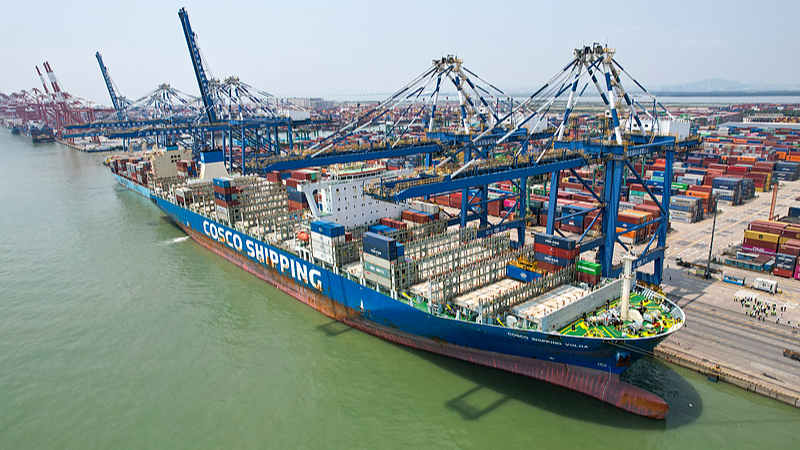
The benefits of this partnership are there for all to see in almost every country. Peru’s Chancay megaport, built with Chinese investment, has reduced shipping times to Asia by nearly two weeks and cut costs logistics by at least 20%, creating a new Pacific gateway for South exports American exports of manufactured goods, agricultural goods and products minerals. In Brazil, Chinese companies have invested billions in renewable energy, electric vehicles (EV) manufacturing and port modernization. Ironically, BYD have built a huge EV factory in the Brazilian state of Bahia, on the exact site that abandoned Ford during US industrial retrenchment.
Washington, by contrast, offers Latin America sticks without cars. They do not offer alternative infrastructure investment, more favorable trade trade terms, or new development partnerships. They don’t offer this because because do not have the ability to do so. The only card they have to play is to simply demand that Latin American countries sever ties with their most important economic partner threat and who refuse those with war and sanctions.
It’s important to understand this aggression as a symptom of its decline. As the US loses its ability to compete financially, it is trying to turn the clock back to the era of Western colonialism. At the Munich Security Conference in February, US Secretary of State Marco Rubio delivered speech to that bade the ideological foundations of the administration’s foreign policy. I have lamented the decline of “great Western empires” in the face of “godless communists.” It was a call for the return of 19th-century imperialism and for the end of sovereignty, self-determination and decolonization. All colonizers have left is to look back on their past glory.
China’s vision for its relationship with Latin America and the Global South could not be more different. At the same Munich conference, Chinese Foreign Minister Wang Yi called for adherence to the purposes and principles of the UN Charter, emphasizing that all countries should be “equal in terms of rights, and opportunities rules.” The UN may not be perfect, but it still represents the sacred principles of peace, sovereignty and self-determination. Surrendering these principles is the path to chaos, war and colonialism.
No turning back.
The Trump administration’s attempt to push back history in Latin America will fail, for the simple reason that it goes against the material interests of the peoples of the region. Cooperation between China and Latin America is growing because it is mutually beneficial. Latin America has won markets for its raw materials, secured investments in urgently needed infrastructure and accessed affordable technology. It is this kind of common prosperity that will survive any president or political conflict.
The nations of Latin America have endured centuries of foreign intervention, from colonialism to Cold War coups and structural adjustment programs that devastated their economies. What the United States now offers under the “Doctrina Donroe” is more of the same: dependence, instability and underdevelopment disguised in the language of security. What China offers is a genuinely new thing: unconditional trade, investment without interference and respect for each nation’s sovereign right to choose its own path of development.
History does not go back. The “Coat of the Americas” will prove to be just a footnote in the irreversible history of South-South cooperation and the solidarity of the Global South.